
Emily's Wonder Lab - Solar Bake Off (S1E10)
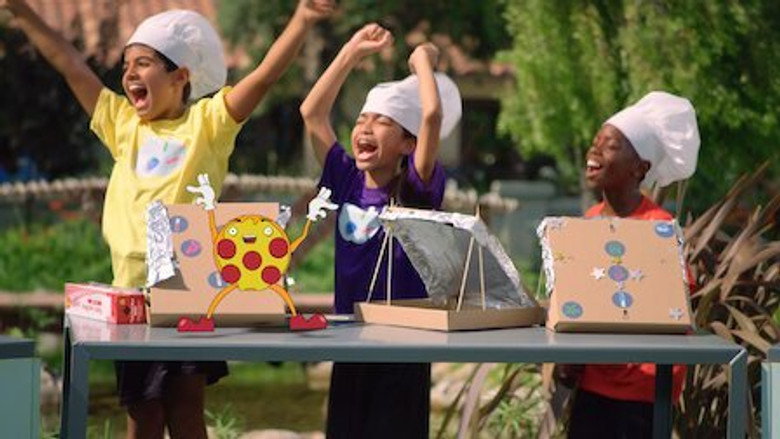
Aluminum foil, plastic wrap and a pizza box are the perfect ingredients for a solar-powered oven. At-home experiment: static electricit
| Runtime (min) | 12 |
|---|---|
| Air Date | 2020-08-25 |
| Genres | Family, Kids |
| TV Rating | TV-G |
| Network(s) | Netflix |
Storyline
In this episode, Emily Calandrelli and her young lab assistants explore the power of solar energy by building their own solar ovens from everyday household materials. Using aluminum foil, plastic wrap, and a pizza box, the team constructs simple but effective ovens that harness the sun's rays to cook food. The experiment demonstrates how reflective surfaces can concentrate sunlight and how the greenhouse effect traps heat inside the box, raising the temperature enough to melt chocolate or warm other treats.
Throughout the episode, Emily guides the kids through each step of the construction process, explaining the science behind why each material matters. The children test their solar ovens outdoors, observing how the sun's energy transforms into heat and produces real cooking results. The episode wraps up with an at-home experiment suggestion focused on static electricity, encouraging young viewers to continue exploring scientific principles on their own.
What parents say
Parents have praised Emily's Wonder Lab for making complex scientific concepts accessible and exciting for elementary-aged children. Many appreciate Emily Calandrelli's enthusiastic hosting style and her ability to break down experiments into clear, manageable steps that kids can follow along with at home. The show's hands-on approach has been highlighted as particularly valuable for encouraging STEM interest in young viewers.
Parents note that the solar oven episode is especially popular because it uses materials most families already have at home, making it easy to replicate the experiment without special purchases. Some parents have mentioned using this episode as a springboard for backyard science days, appreciating that the experiments are safe and produce visible results that keep children engaged. The short runtime has also been cited as ideal for younger attention spans while still delivering meaningful educational content.
What kids learn
Children learn fundamental concepts about solar energy and renewable resources through this hands-on episode. By building their own solar ovens, kids discover that the sun's energy can be captured, concentrated, and converted into heat for practical purposes. They observe how reflective materials like aluminum foil redirect sunlight, how dark surfaces absorb heat, and how transparent materials like plastic wrap create a greenhouse effect that traps warmth inside the box.
The episode also teaches the scientific method in action. Kids see how Emily and her assistants make predictions, test their solar ovens, and observe the results, reinforcing the importance of experimentation and observation in science. The connection between everyday materials and scientific principles helps children understand that science isn't confined to laboratories but exists all around them.
Beyond the specific physics concepts, children gain confidence in their ability to conduct experiments independently. The episode's encouragement to try the solar oven at home, along with the static electricity bonus experiment, empowers kids to see themselves as capable scientists who can explore and discover on their own.
Parents' top 5 questions
| Question | Answer |
|---|---|
| Is it safe for my child to build and use a solar oven? | Yes, the solar oven experiment is very safe when supervised. The materials used are common household items with no sharp edges or toxic components. While the oven does generate heat, it reaches temperatures warm enough to melt chocolate but not hot enough to cause burns. Parents should supervise younger children during construction and when placing the oven in direct sunlight, and remind kids not to touch the interior surfaces immediately after use. |
| Do we really need a pizza box, or can we use something else? | A pizza box works best because of its size, insulation properties, and hinged lid design, but you can adapt the experiment with other cardboard boxes. The key is finding a box with a lid that can be propped open to create a reflective flap. Shoeboxes or shipping boxes can work if you modify them appropriately. The cardboard provides insulation that helps trap heat inside the oven. |
| What can my child actually cook in a solar oven? | Solar ovens built from pizza boxes reach temperatures between 150 and 200 degrees Fahrenheit on sunny days, which is perfect for melting chocolate, softening cheese, warming cookies, or making s'mores. They work best with foods that don't require high heat or long cooking times. This is a demonstration of solar energy principles rather than a replacement for conventional cooking, so set expectations accordingly. |
| Will this experiment work on a cloudy day or in winter? | Solar ovens require direct sunlight to function effectively, so cloudy days will produce minimal results. However, they can work in winter as long as the sun is shining brightly, though the ambient cold temperature may reduce efficiency. The best results come from clear, sunny days when the sun is high in the sky. If weather doesn't cooperate, you can still build the oven and test it when conditions improve. |
| How does this episode connect to the static electricity experiment mentioned? | The static electricity experiment is presented as a separate at-home activity rather than being directly connected to the solar oven theme. Emily's Wonder Lab typically includes bonus experiment suggestions at the end of episodes to give families additional hands-on activities to explore. Both experiments teach different aspects of physics and energy, encouraging children to continue their scientific exploration beyond the main episode topic. |
Writing
Directing
| Season # | Episode # | Episode Name |
|---|---|---|
| 1 | 1 | Emily and the crew get curious about ultraviolet light, then mix up their own fluorescent paint. At-home experiment: lava lamp. |
| 1 | 2 | The kids learn the science behind non-Newtonian fluids, then try to walk — and dance! — across an ooey-gooey pool. At-home experiment: oobleck. |
| 1 | 3 | Emily takes her scientists outside to get messy, making colorful explosions with chemical reactions. At-home experiment: rainbow bubbles |
| 1 | 4 | The kids learn all about tornados — then Emily shows them how to make one indoors! At-home experiment: tornado in a bottle. |
| 1 | 5 | How do you test the strength of ordinary chicken eggs? By walking across a whole floor of them ... barefoot. At-home experiment: egg in a bottle |
| 1 | 6 | A pool filled with glue helps the gang learn all about cross-linking polymers. (Hint: They're making slime!) At-home experiment: meteorite slime. |
| 1 | 7 | Brace yourself! The kids are making high-powered air cannons out of shower curtains, bungee cords and trash cans. At-home experiment: cloud in a bottle. |
| 1 | 8 | Inspired by Newton's third law of motion, the kids build balloon-powered cars, then race them to see who wins. At-home experiment: hovercraft. |
| 1 | 9 | The scientists scare up flying ghosts and bubbling witch’s brew with rising heat and acid-base reactions. At-home experiment: barfing pumpkin. |
| 1 | 10 | Aluminum foil, plastic wrap and a pizza box are the perfect ingredients for a solar-powered oven. At-home experiment: static electricit |
This product uses the TMDB API but is not endorsed or certified by TMDB.